
Thermal Inspection
Thermal Drone Inspection
“See heat. Find faults. Make decisions.”
Radiometric thermal imaging across building envelopes, electrical infrastructure, industrial assets, and mechanical systems. Detect heat loss, water ingress, and equipment failure before they become incidents.
Overview
What you get when you engage Drone Inspect for thermal inspection.
Heat tells the truth about a building, an electrical board, a roof membrane, or a mechanical pump. Visible-light photography misses it entirely. A radiometric thermal camera mounted on a stable drone platform captures temperature data across thousands of square metres in minutes.
Our pilots hold both CASA RePL and infrared thermography qualifications, so the imagery comes with interpretation, not just pretty pictures. Every report identifies the fault, quantifies the temperature delta, and explains what action is required and how urgently.
For facility managers, electrical engineers, building consultants, and insurance assessors, thermal drone inspection turns invisible problems into documented evidence with sub-centimetre spatial accuracy.
Capabilities
What is included in every thermal inspection engagement.
Radiometric Sensors
DJI H20T and Mavic 3T enterprise payloads delivering 640x512 thermal resolution with ±2°C accuracy and per-pixel temperature data.
Building Envelope Surveys
Heat loss mapping, insulation gap detection, water ingress tracing, and air leakage paths. Compatible with NABERS and Green Star reporting.
Electrical Infrastructure
Switchboards, transformers, busbars, and overhead lines. Detect loose connections, overloaded circuits, and failing components before fire risk.
Mechanical Plant
Cooling towers, chillers, pumps, and condensers. Identify bearing failures, motor overheating, and refrigerant blockages.
Quantified Findings
Every defect reported with temperature delta, ambient reference, and severity classification per ISO 18434 thermal imaging standards.
Multi-Spectral Reports
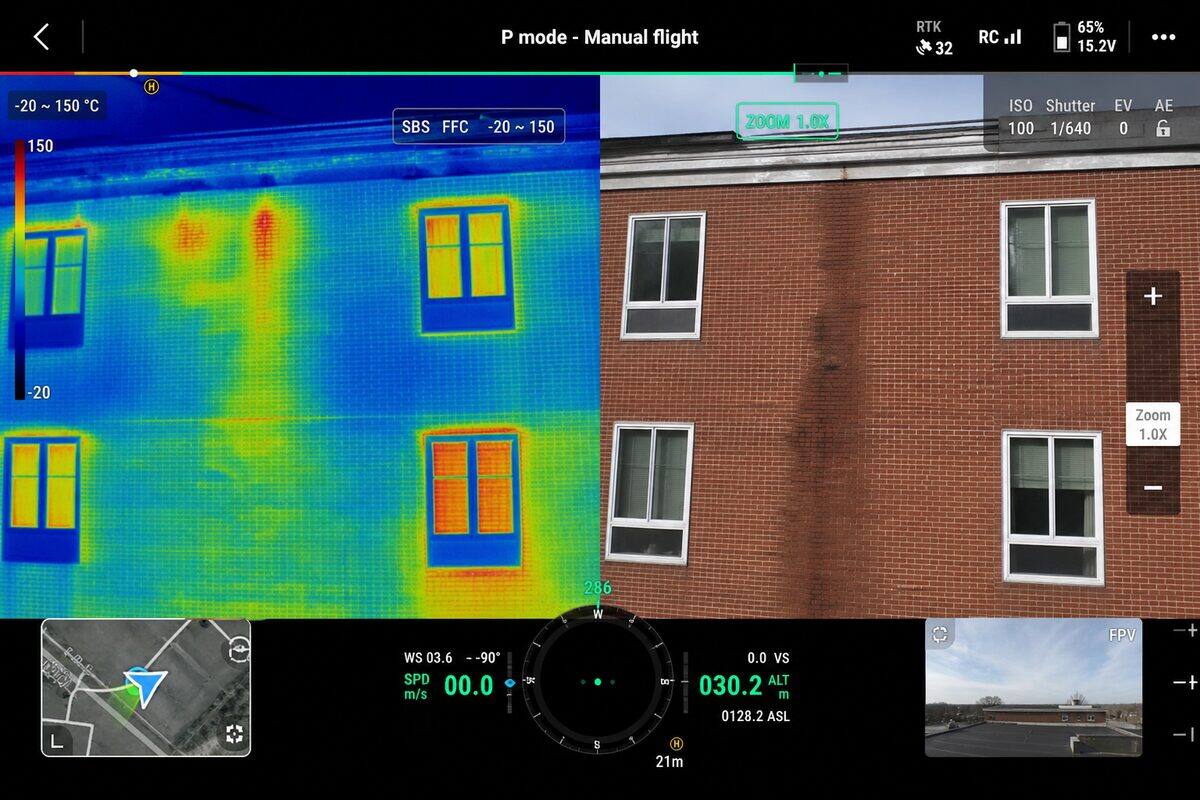
Side-by-side thermal + visible imagery with consistent framing. Engineers can correlate every hotspot with a physical asset photo.
FAQ
Common questions about thermal inspection.
When is thermal drone inspection better than ground-based thermal?
Whenever access is dangerous, time-sensitive, or covers a large area. Roof membranes, solar farms, overhead powerlines, multi-storey building facades, telecommunications towers, and large industrial sites are all classic drone-thermal use cases. Ground-based thermal remains preferred for indoor electrical inspections and small confined-space assets.
Do you provide certified thermography reports?
Yes. Our chief thermographer holds Level II Infrared Training Center (ITC) certification, the international standard for thermography reporting. Reports are formatted per ISO 6781 (building envelope) or ISO 18434-1 (machinery) depending on the asset class, suitable for insurance, compliance, and engineering use.
What weather conditions do you need?
For building thermal: cold sky, no rain, 1+ hour after sunset is ideal (best contrast). For solar: clear sky, 600 W/m² minimum irradiance, low wind. For electrical: dry conditions, equipment loaded above 40% nameplate. We monitor conditions and reschedule when forecasts threaten data quality, at no cost.
Get a thermal inspection quote in 24 hours.
Send us the address and what you need to know. Fixed-price quote in writing within one business day.
Request Quote